What Is PVC Film? Types, Properties and Industrial Applications
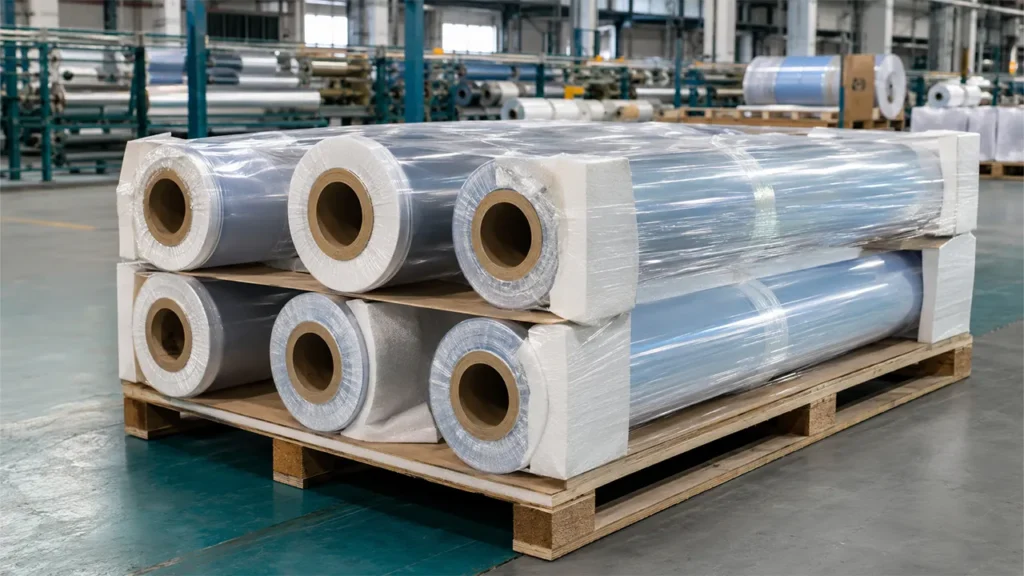
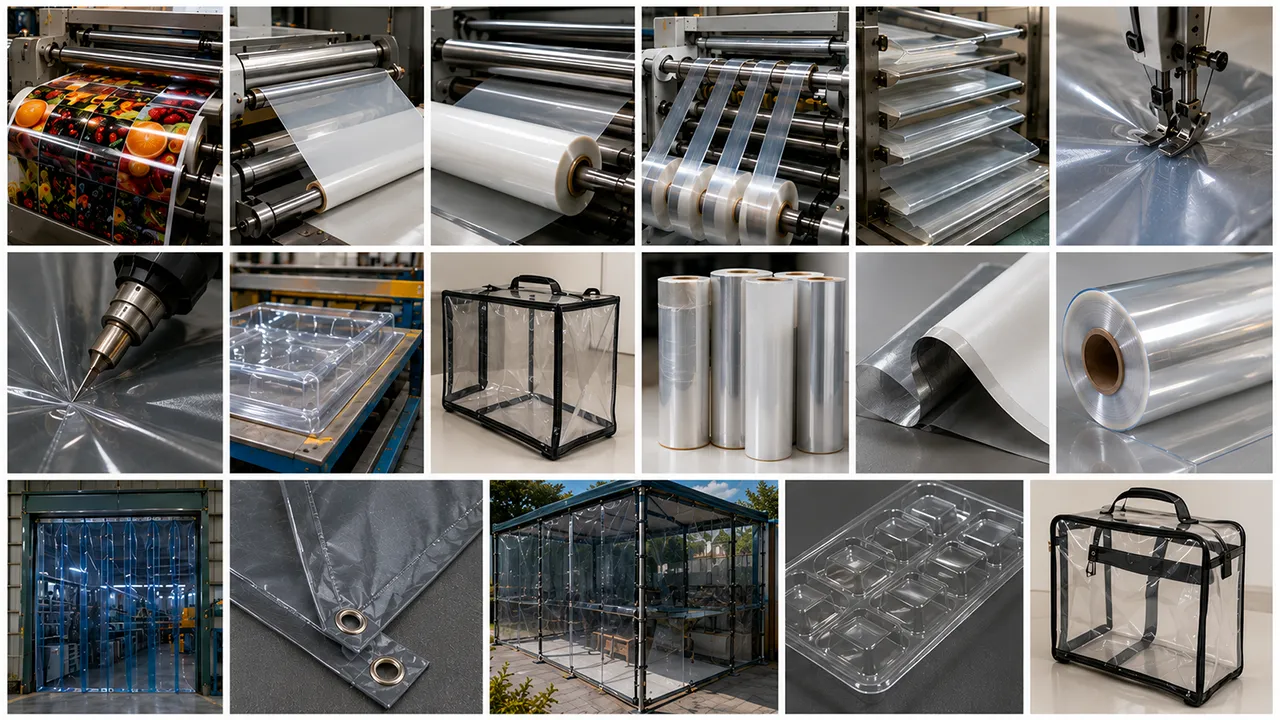
PVC film is a thin material made from polyvinyl chloride. It can be flexible, semi-rigid, or rigid. Manufacturers use it for printing, lamination, decorative surfaces, industrial covers, and many other converted products. Buyers should not choose PVC film by name alone. They need to match the film’s formula, size, surface, tested properties, converting process, and working environment. This guide explains those decisions in a practical order.
Buyers should not choose PVC film by name alone. They need to match the film’s formula, size, surface, tested properties, converting process, and working environment. This guide explains those decisions in a practical order.
For commercial options, review PVC film products for industrial converting PVC Film Products.
Buyer takeaway: PVC film is not one fixed material. A useful specification describes the film’s composition, form, surface, roll format, measured properties, converting process, and end-use conditions together.
What Is PVC Film?
PVC film is a continuous, thin material made from PVC resin and selected additives. The formula and production process work together. They decide whether the film is flexible or rigid, clear or opaque, and smooth or embossed.
PVC Film Composition
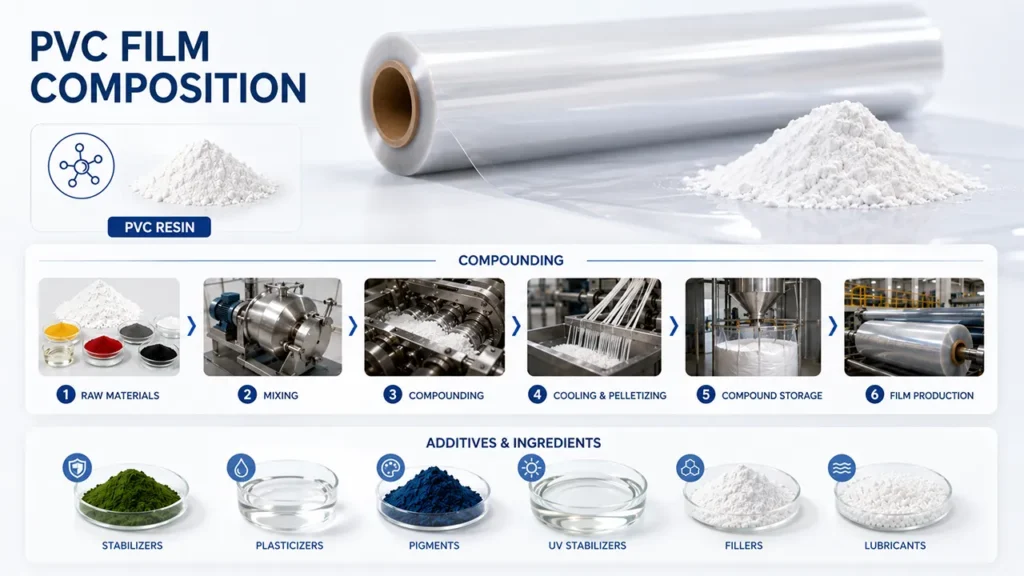
PVC resin starts as a powder. Before it can become film, the manufacturer mixes it with other materials. This step is called compounding. The formula may include processing stabilizers, plasticizers for flexibility, pigments for color, UV stabilizers, fillers, and lubricants. The European Council of Vinyl Manufacturers explains that these controlled recipes help give PVC its wide range of uses.
An additive alone does not prove how the finished film will perform. A flame or UV claim must identify the exact sample, the test method, and the result that counts as a pass.
How PVC Film Is Formed
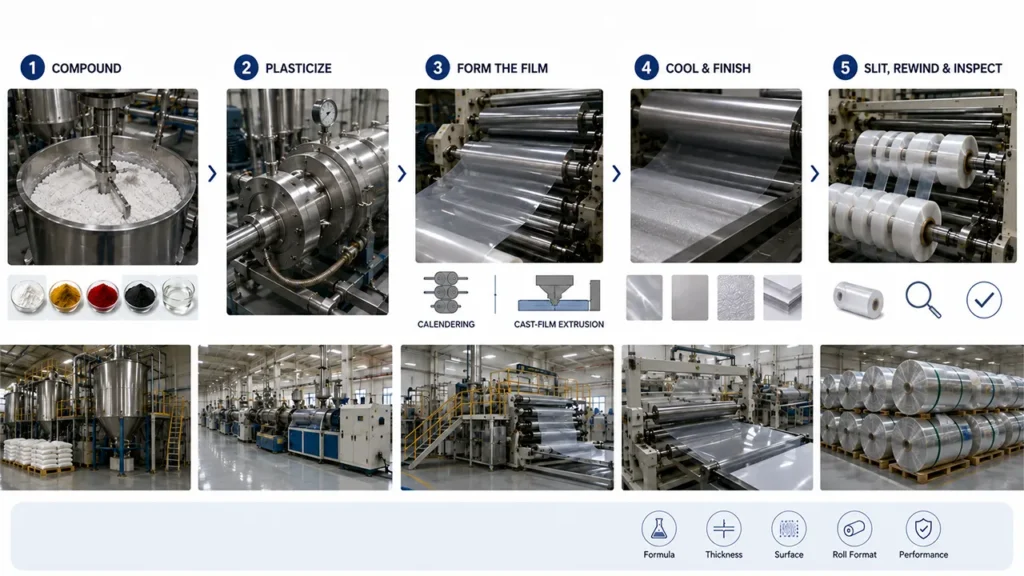
PVC film production normally follows five stages:
- 1. Compound the formulation. Mix PVC resin with additives for flexibility, color, stability, surface, and function.
- 2. Plasticize the compound. Apply controlled heat and shear for consistent forming.
- 3. Form the film. Calendering controls gauge and surface through sequential rolls; cast-film extrusion passes material through a die and cools it on a roll or band. The British Plastics Federation identifies calendering as a major PVC film-and-sheet process.
- 4. Cool and finish. Apply the required polish, matte surface, embossing, coating, or lamination.
- 5. Slit, rewind, and inspect. Prepare rolls to the confirmed format and quality requirements.
The manufacturing method is only one part of the specification. Calling a film “calendered” or “cast” does not define its formula, thickness, surface, roll format, or performance.
What Are the Main Types of PVC Film?
PVC film can be classified in several ways at the same time. One film may be flexible, clear, calendered, embossed, and specially formulated. Buyers should combine these labels instead of choosing only one. Otherwise, two different films may appear to be the same product.
Flexible, Semi-Rigid and Rigid PVC Film
Flexible PVC film is designed to bend, fold, drape, or follow a shape. Semi-rigid film is stiffer but can still bend. Rigid PVC keeps its shape and has limited flexibility. The ECVM overview of PVC properties explains that the formula can change this behavior. A marketing name alone does not define the level of flexibility.
At YESIN, our confirmed manufacturing scope is flexible PVC film only. We do not supply rigid or semi-rigid PVC film, so the broader industry classification in this article should not be read as a YESIN product claim. Related commercial intent should be routed to flexible PVC film PVC Industrial Film.
Calendered and Extruded PVC Film
Calendering forms the film between a series of heated rolls. Extrusion pushes softened material through a shaped opening called a die. In a cast-film process, the film is then cooled on a roll or band. No method is always better. The right choice depends on the formula, thickness, surface, order needs, and converting process.
YESIN’s verified production scope includes in-house calendering and cast flexible PVC film production. A separate independent extrusion production line has not been confirmed, so the accurate company wording remains “calendered and cast flexible PVC film production.” For a deeper process explanation, add an internal link to how calendered PVC film is produced PVC Film Manufacturing Process.
Clear, Colored, Embossed and Functional Film
Appearance and function add another layer. Clear film can be judged by how much light passes through it, how cloudy it looks, its tint, and its surface. Colored film may be transparent, partly transparent, or opaque. Labels such as flame-retardant or UV-resistant are incomplete unless the required test is also stated.
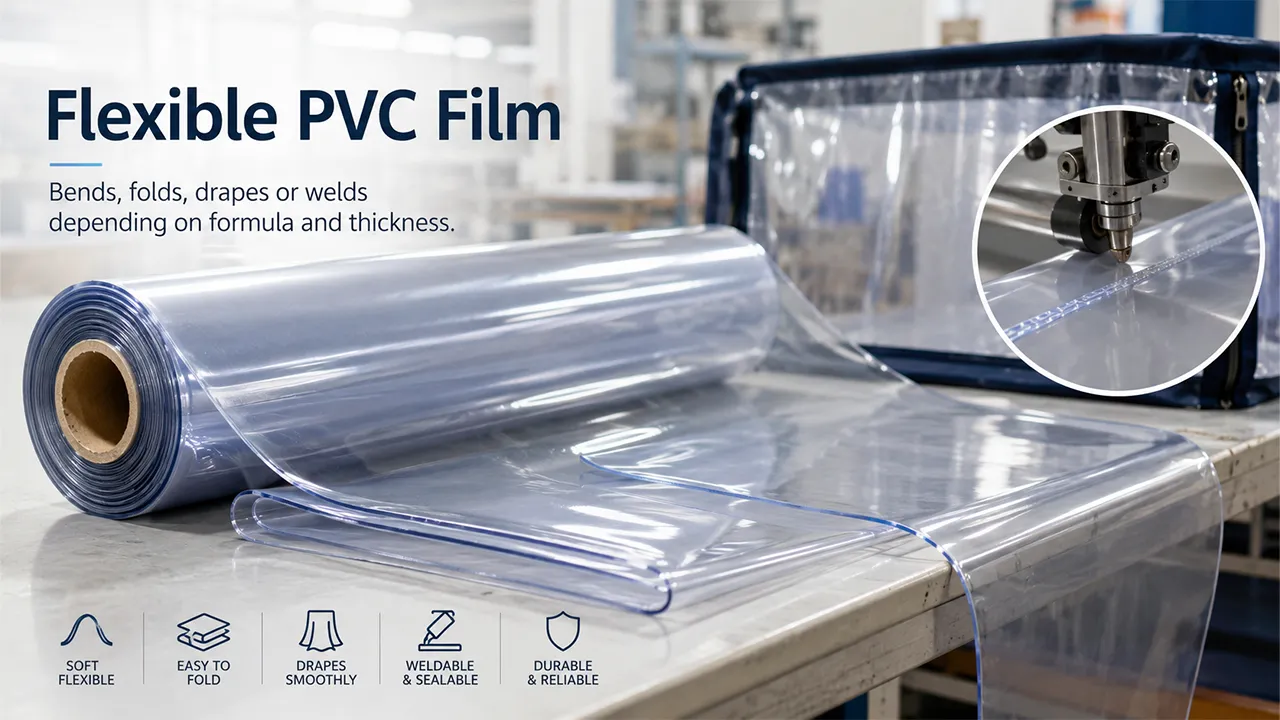
Flexible PVC Film
Bends, folds, drapes or welds depending on formula and thickness.
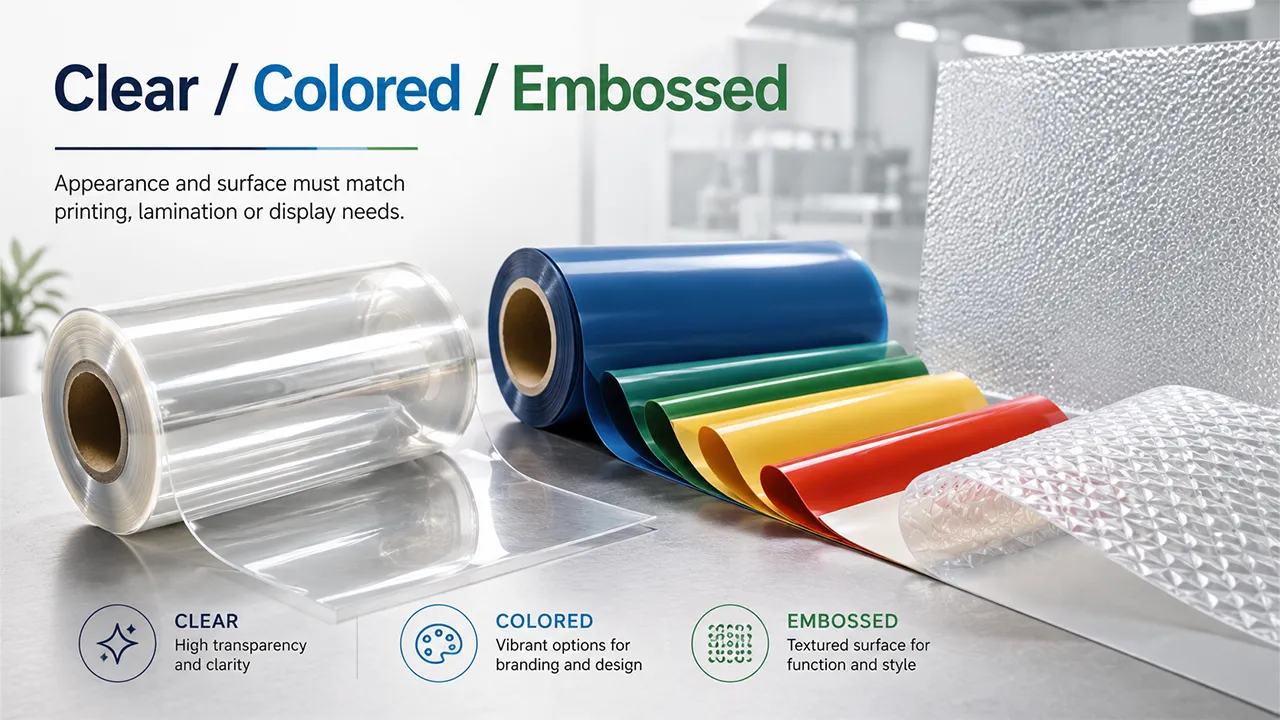
Clear / Colored / Embossed
Appearance and surface must match printing, lamination or display needs.
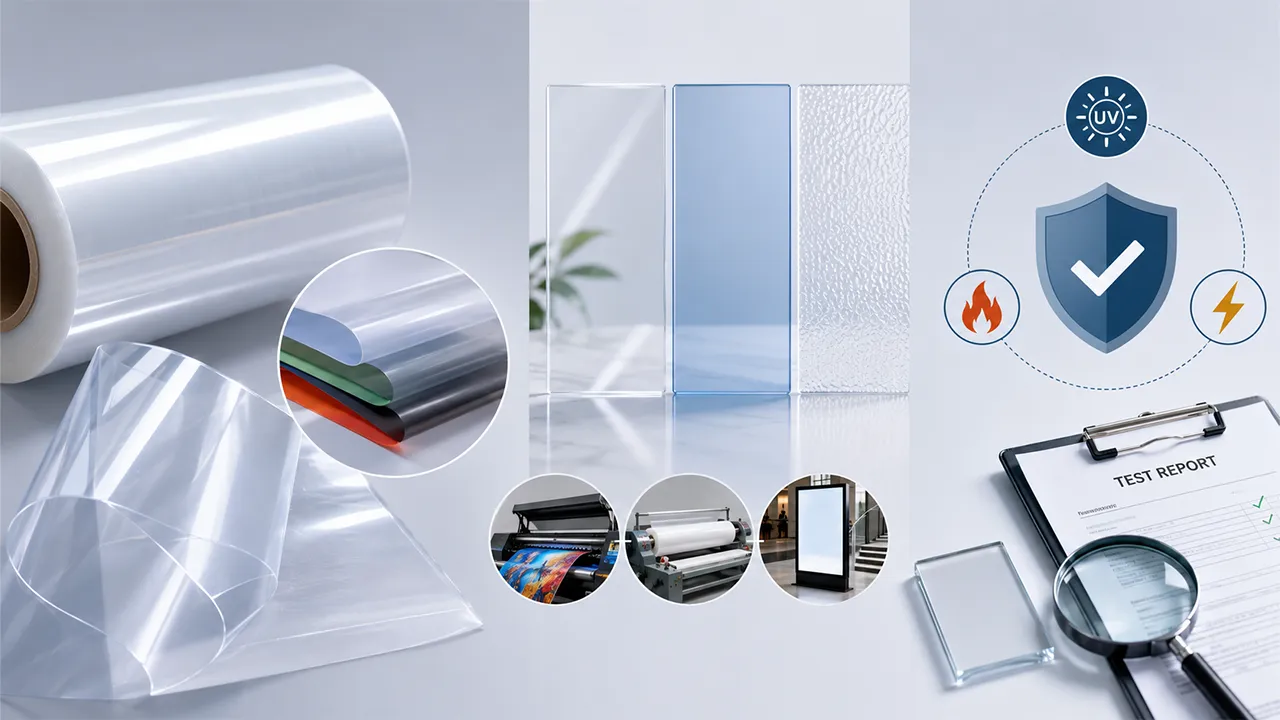
Functional Film
UV, flame or static claims need test method, sample and result boundaries.
| Classification Basis | Type | Defining Feature | Buyer Question | YESIN Evidence Boundary |
|---|---|---|---|---|
| Flexibility | Flexible, semi-rigid, rigid | Bending and stiffness behavior | What behavior is required in service? | YESIN supplies flexible PVC film only |
| Forming method | Calendered, extruded/cast | How film is shaped and cooled | Which route fits the conversion? | Calendering and cast flexible-film production are confirmed |
| Optical appearance | Clear, tinted, translucent, opaque | Transmission, haze, clarity, color | Which optical property matters? | Clear and colored flexible films are confirmed; no universal optical value |
| Surface | Smooth, matte, glossy, embossed, textured | Finish and texture | Is printing, bonding, texture, or glare control required? | Embossing is confirmed; exact textures are order-specific |
| Function | UV-stabilized, flame-retardant, modified grades | Formulation targets a performance | Which standard and specimen apply? | Formulations are conditional; no rating or service life is implied |
Which PVC Film Properties Matter Most?
The most important properties are the ones that affect converting and the finished product. A test number is useful only when the buyer knows how it was measured. The unit, test method, sample condition, and pass/fail rule must be clear.
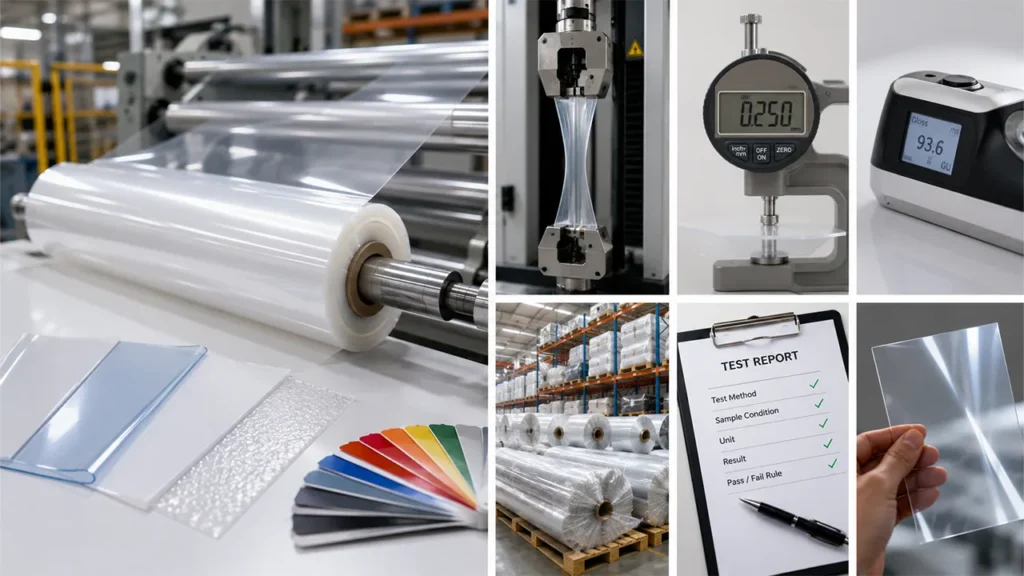
Dimensions and Roll Specifications
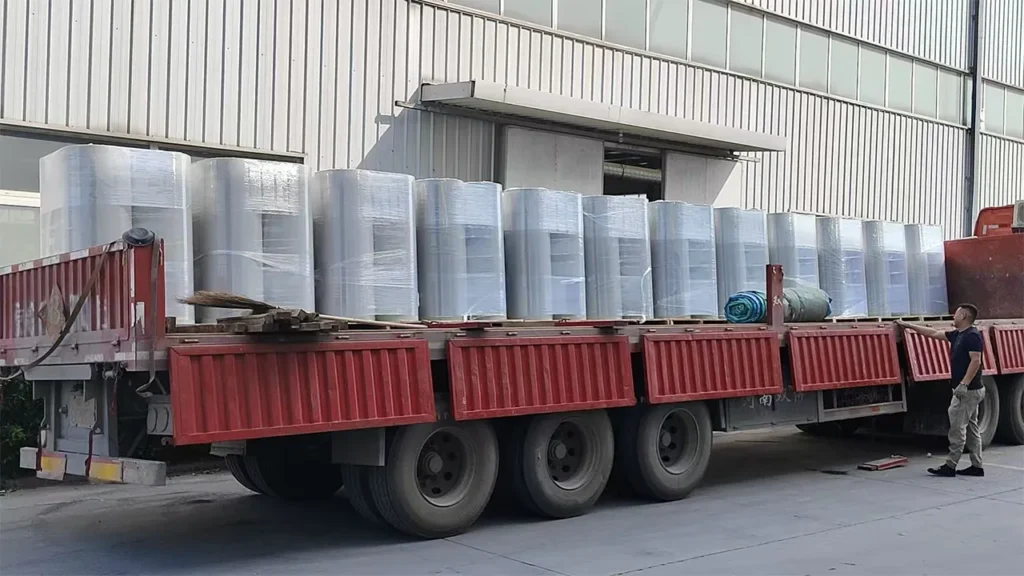
Thickness affects flexibility, weight, appearance, forming, and handling. Width must fit the buyer’s machine. The buyer should also state whether the width is the total web width, the trimmed width, or the usable width. Roll length should be checked together with roll weight, core size, roll diameter, joints, and machine limits.
At YESIN, we ask buyers to state the target thickness, usable width, roll format, core, and machine limits. We use this information before confirming a custom roll. YESIN can customize thickness, slit and rewind film, and make fixed-length or fixed-weight rolls. The verified maximum finished width is 1450 mm. Other limits, tolerances, core sizes, roll lengths, and packaging must be confirmed for the order.
Mechanical and Optical Properties
Tensile strength shows how the film behaves when it is pulled. Elongation shows how far it stretches before it breaks. Results can be compared only when the laboratories use the same sample preparation, test speed, grips, direction, and measuring method. ASTM D882-26 explains these conditions.
Hardness depends on the test method. ASTM D2240-15(2021) explains that different durometer types cannot be converted with a simple formula. A hardness value should name the scale, temperature, sample thickness, conditioning, and method.
For transparent film, haze and luminous transmittance measure different things. Haze is the light scattering that makes a film look cloudy. Luminous transmittance measures how much visible light passes through. ASTM D1003-21 covers both properties. A label such as “super clear” cannot replace an agreed value and test method.
Surface and Converting Properties
Surface finish affects appearance, friction, printing, adhesive contact, and even some measurements. Process compatibility depends on the complete system. The film, ink or adhesive, machine, settings, environment, and final product all matter.
| Property | What It Describes | Processing Effect | Finished-Product Effect | Verification |
|---|---|---|---|---|
| Thickness and tolerance | Film gauge and allowed variation | Web handling, forming, welding, coating weight, roll build | Flexibility, mass, optics, dimensional consistency | Agreed nominal value, points, method, and surface condition |
| Width and roll format | Usable web dimensions and winding format | Machine fit, trim waste, tension, changeovers | Production efficiency and usable yield | Net width, roll length/weight, diameter, core, joints |
| Hardness or flexibility | Resistance to indentation and practical bending behavior | Folding, feeding, forming, welding, sewing | Drape, stiffness, low-temperature response | Scale, standard, temperature, specimen thickness |
| Tensile strength and elongation | Response to controlled tensile loading | Web tension and risk of stretch or break | Load response and deformation | Standard, direction, speed, specimen, conditioning |
| Transmission, haze, clarity | How light passes through or scatters | Inspection and print/lamination appearance | Visibility, diffusion, display quality | Optical property, method, specimen thickness and surface |
| Surface finish | Gloss, matte, smoothness, or texture | Printing, coating, lamination, friction, measurement | Appearance, touch, glare, handling | Approved surface sample and process trial |
| Converting compatibility | Interaction with ink, adhesive, heat, radio-frequency (RF) welding, or sewing | Bonding, print cure, seam formation, line stability | Adhesion, seam strength, appearance, durability | Material trial under production-relevant settings |
For detailed specification intent, add how to select PVC film thickness PVC Film Thickness Guide.
How Do PVC Film Types and Properties Match Industrial Applications?
Choose PVC film by what it must do, where it will be used, and how it will be converted. Do not choose it from the application name alone. Two similar products may need different films because the ink, adhesive, machine, temperature, exposure, or approval rule is different.
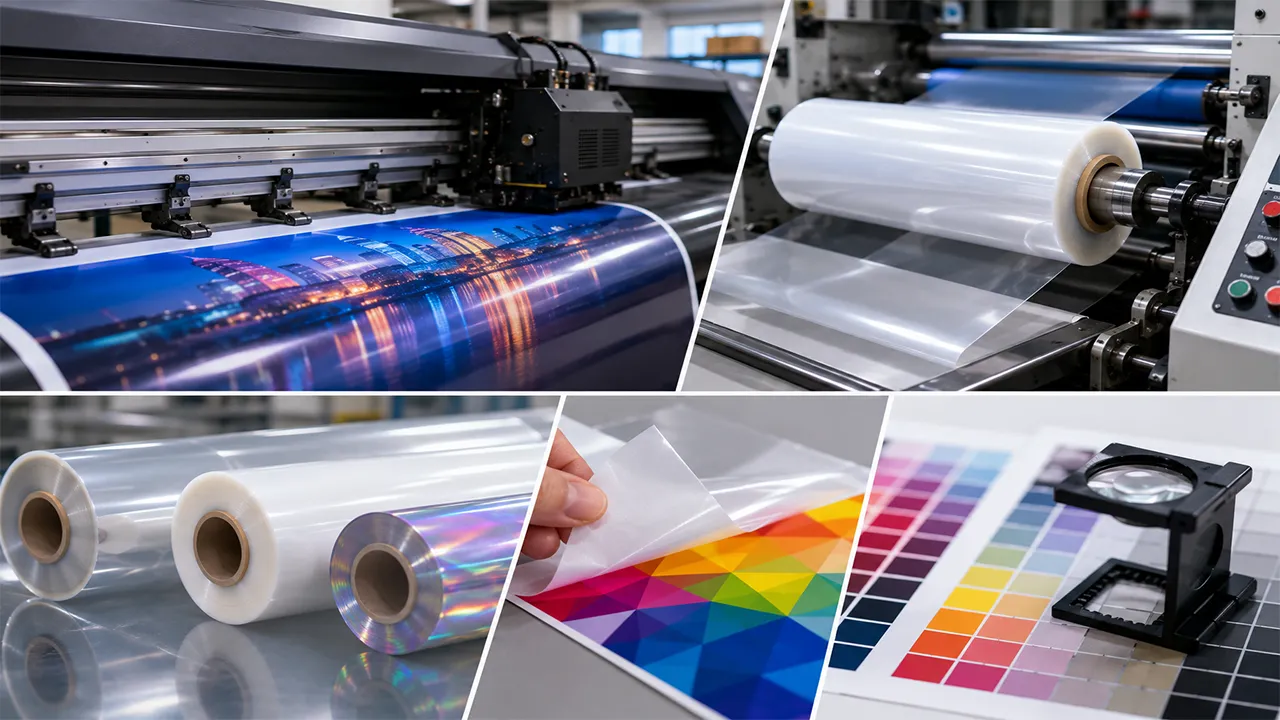
Printing, Lamination and Graphics
For printing, the film surface must work with the ink, curing method, and any surface treatment. For lamination, the buyer must confirm the adhesive, coating amount, release liner, peel requirement, and substrate. Test the complete film and process before approval. A clear overlaminate and a printed base film do not need the same properties.
YESIN’s verified capabilities include adhesive coating for flexible PVC films, release-paper lamination for PVC decorative films, slitting, rewinding, and surface embossing. Those capabilities do not establish universal compatibility with every ink, adhesive, printer, or graphics application. Relevant product links should be added only after the actual URLs and product scope are confirmed Cold Lamination Film.
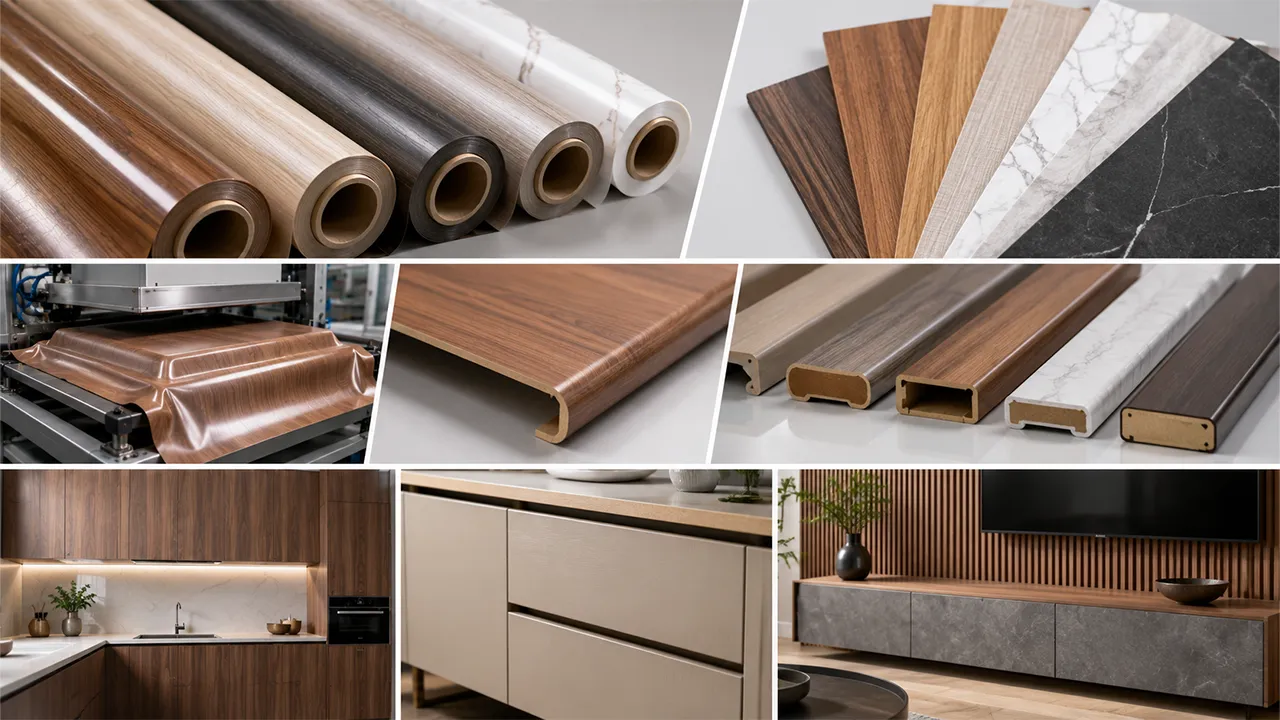
Furniture and Decorative Surfaces
Decorative film may be laminated onto a flat panel, wrapped around a profile, or formed by vacuum pressing. The buyer should state the substrate, adhesive, heat, shape, opacity, gloss, texture, design direction, color reference, and any protective layer.
For custom color work at YESIN, we begin with a Pantone code, physical sample, or mutually approved reference, then obtain sample approval before bulk production. Standard and custom embossing, coating, and release-paper lamination for PVC decorative films are also confirmed capabilities. Specific furniture, cabinet, door, wall-panel, or exterior suitability remains product- and process-specific. Add a contextual solution link after the application scope is approved PVC Decorative Film.
Furniture and Decorative Surfaces
Decorative film may be laminated onto a flat panel, wrapped around a profile, or formed by vacuum pressing. The buyer should state the substrate, adhesive, heat, shape, opacity, gloss, texture, design direction, color reference, and any protective layer.
For custom color work at YESIN, we begin with a Pantone code, physical sample, or mutually approved reference, then obtain sample approval before bulk production. Standard and custom embossing, coating, and release-paper lamination for PVC decorative films are also confirmed capabilities. Specific furniture, cabinet, door, wall-panel, or exterior suitability remains product- and process-specific. Add a contextual solution link after the application scope is approved PVC Decorative Film.
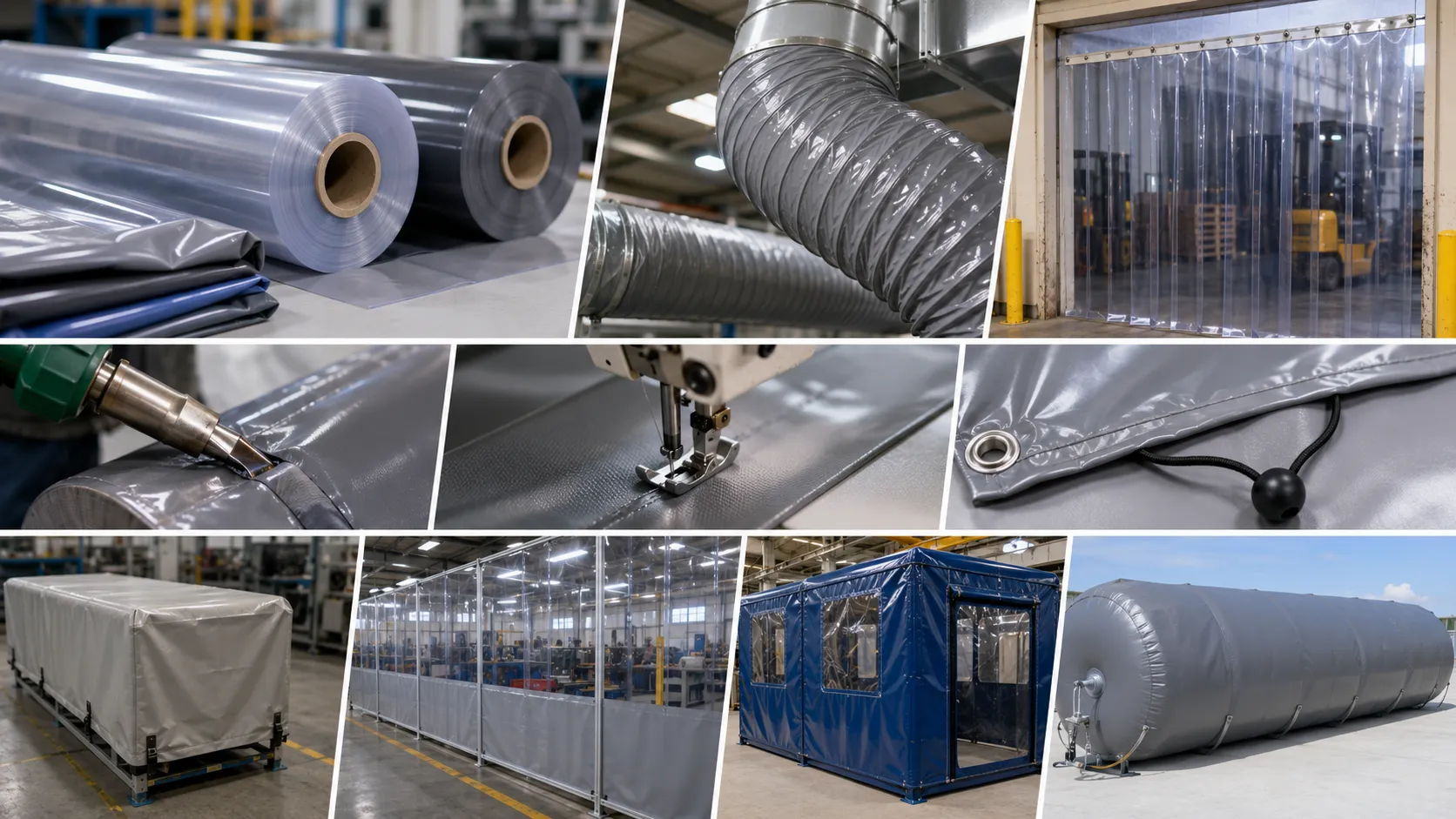
Industrial Covers, Ducts and Converted Products
Industrial covers, ducts, partitions, curtains, sewn products, and welded parts may need special strength, low-temperature, seam, optical, flame, or UV performance. First check whether the request is for film alone or for a coated or reinforced structure. Then test the complete structure.
| Application | Required Function | Relevant Film Category | Critical Buyer Inputs | Validation Before Order |
|---|---|---|---|---|
| Printing and graphics | Stable web, surface, appearance | Clear, colored, smooth, matte, or coated film | Ink, curing, pretreatment, surface, roll | Print and adhesion trial |
| Lamination | Adhesive compatibility | Film with confirmed coating/liner structure | Adhesive, coating, liner, peel, substrate | Lamination and peel evaluation |
| Decorative surfaces | Color, opacity, texture, forming | Colored or decorative flexible film | Substrate, adhesive, heat, radius/draw, gloss | Approved sample and line trial |
| Industrial cover/partition | Flexibility, visibility, seam, exposure | Flexible clear, tinted, colored, or textured film | Structure, temperature, seam, cleaning, weathering | Material and assembly trial |
| Duct or welded conversion | Weld and mechanical behavior | Application-specific film or composite | Welding, reinforcement, tensile, temperature, flame | Seam and functional tests |
| Outdoor/functional use | Verified UV, flame, static, or other function | Formulation-specific film | Standard, specimen, duration, climate | Exact report plus application trial |
Application-specific links, including flexible PVC film for air-duct manufacturing, should remain placeholders until YESIN’s supplied product scope and URLs are confirmed Flexible Air Duct Film.
How Should Buyers Choose PVC Film and Avoid Wrong Selection?
Define the finished product and converting method before choosing thickness, hardness, surface, or special performance. If the order is reversed, the specification may look complete but the film may still fail to print, bond, weld, form, or run correctly.
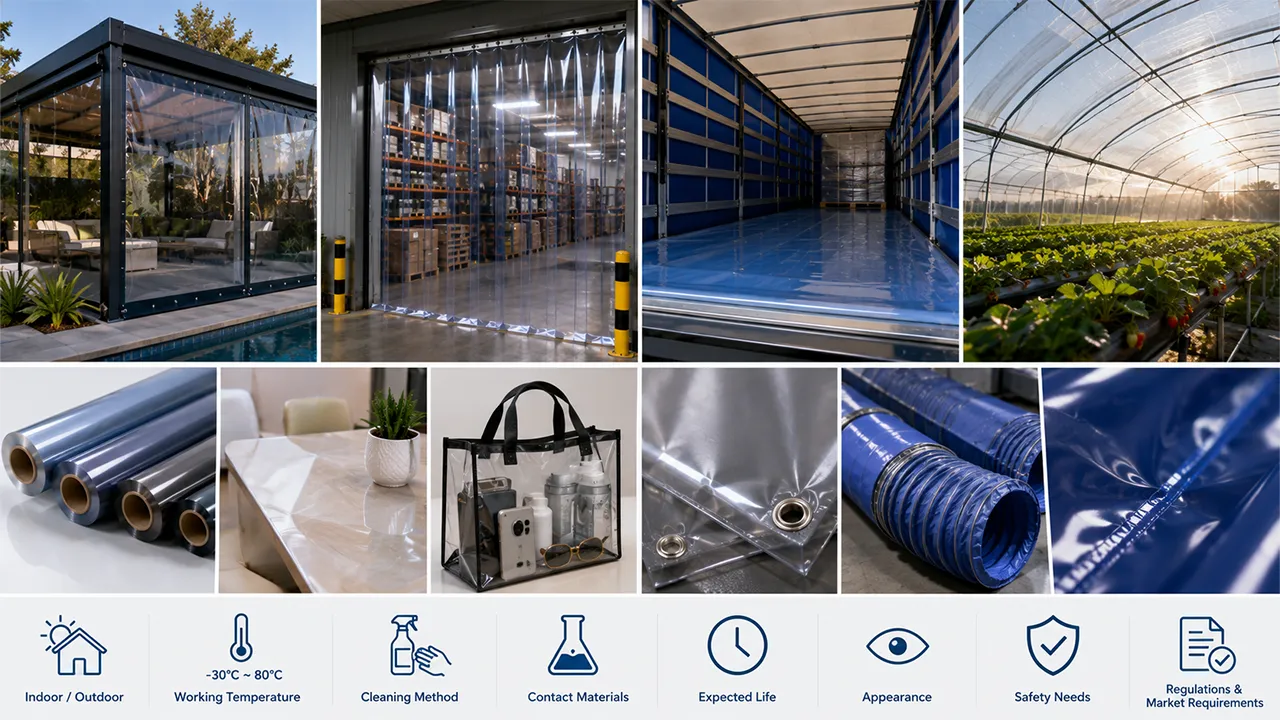
Define the Application and Environment
Start with the finished product, not the raw film. State where it will be used and whether the use is indoors or outdoors. Add the working temperature, cleaning method, contact materials, expected life, appearance, safety needs, and market rules. Separate must-have requirements from preferences.
Match the Converting Method
List every operation the film will go through, such as printing, coating, lamination, slitting, folding, sewing, welding, forming, or assembly. When possible, also provide the ink, adhesive, substrate, machine, working temperature, line speed, and an existing reference material.
Validate the Specification
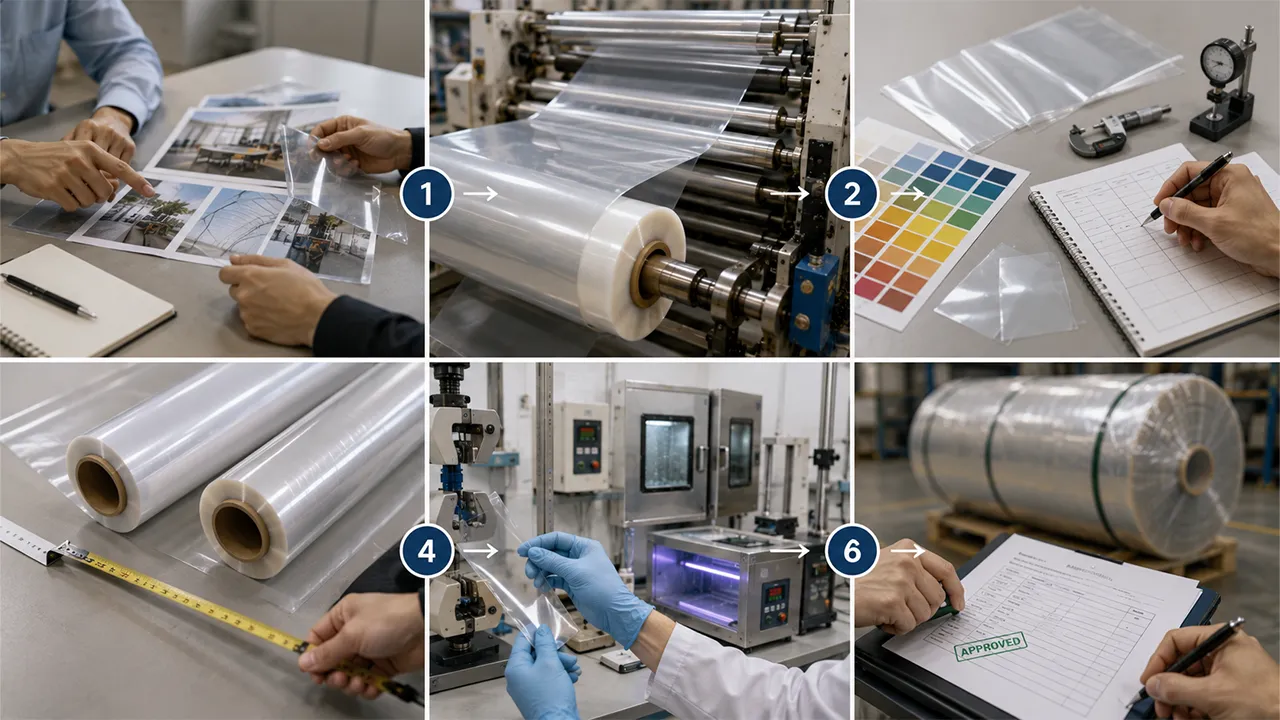
Use a six-step selection flow:
- 1. Define the finished application and exposure.
- 2. Identify the film structure and converting route.
- 3. Translate performance needs into measurable properties.
- 4. Agree dimensions, roll format, appearance, and test methods.
- 5. Test a representative sample under production-relevant conditions.
- 6.Approve the sample and record the specification before mass production.
Selection errors can occur when buyers compare different hardness scales or approve “clear” without a haze target. Other risks include assuming every surface can be printed, requesting outdoor use without a weathering test, or asking for a flame rating without naming the test and sample structure.
Mid-page CTA: Send your target thickness, width, roll format, surface, and processing requirements for a preliminary specification review. Values and tolerances remain subject to the confirmed application, method, and product specification.
How Should Buyers Verify PVC Film and Prepare a Technical Inquiry?
Verify PVC film with a written specification and a test that reflects the real application. Then place the order against a complete technical inquiry. A product name or visual sample alone is not enough for repeat orders.
TDS, Test Reports and Samples
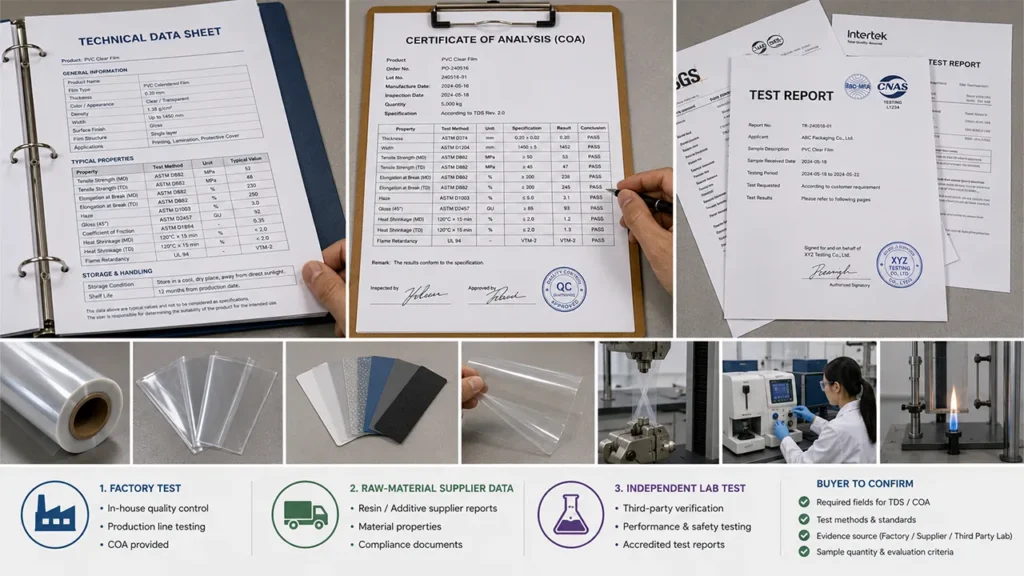
A Technical Data Sheet (TDS) describes the confirmed product and its stated properties. A Certificate of Analysis (COA) or inspection result records agreed data for a batch or order. The buyer should state which fields are needed. The buyer should also say whether the evidence must come from the factory, a raw-material supplier, or an independent laboratory.
At YESIN, we first confirm the product, target market, test method, pass/fail rule, and type of evidence. We can then define the document and sample support for that request. This may include a product-specific TDS, COA or inspection results, relevant tests, applicable REACH or RoHS documents, and existing or custom samples. The report source, formula, validity, sample cost, MOQ, and lead time still need order-specific confirmation.
Application-Specific Limitations
Test results apply only to the exact sample and test conditions. When comparing suppliers, use the same standard, test direction, thickness, sample preparation, equipment, and reporting method.
UL Solutions explains that UL 94 classifications use different controlled tests and that VTM ratings are not equivalent to similarly numbered V ratings. Never transfer a rating between structures, thicknesses, colors, or methods.
Outdoor, food-contact, medical, electrical, and other regulated uses require application- and market-specific evidence. This article makes no YESIN claim for those uses beyond the conditional availability of UV-stabilized formulations and relevant testing when a project is defined.
Validate the Specification
Use a six-step selection flow:
| Inquiry Field | Information to Provide | Why It Matters |
|---|---|---|
| Application and market | Finished product, country/region, indoor/outdoor environment, service conditions | Establishes use and regulatory context |
| Film structure | Unsupported, coated, laminated, printed, embossed, or reinforced | Prevents confusion between base film and converted material |
| Converting process | Printing, coating, lamination, welding, sewing, forming, slitting | Determines compatibility and trial requirements |
| Dimensions and roll | Target thickness, net width, length or weight, diameter, core, joints | Defines machine fit, handling, and yield |
| Appearance | Clear/tinted/opaque, color reference, haze/transmission, gloss, texture | Creates an approvable visual standard |
| Performance | Mechanical, optical, flame, UV, static, migration, or other target | Converts a marketing label into measurable requirements |
| Test and evidence | Standard, method, direction, conditioning, acceptance criterion, report type | Makes supplier data comparable |
| Commercial planning | Estimated quantity, sample quantity, deadline, packaging and labeling | Supports sampling, production, and quotation review |
Closing CTA: Send the finished-product application, converting method, target dimensions, and required tests. Use them to request a relevant TDS, sample, or quotation Contact YESIN.
Frequently Asked Questions About PVC Film
What is PVC film made of?
PVC film is made from polyvinyl chloride resin mixed with additives for processing and end use. These may include stabilizers, plasticizers, pigments, lubricants, or UV stabilizers. The ingredient list alone does not prove how the finished film will perform. Important properties still need a clear specification and test.
Is PVC film flexible or rigid?
PVC film can be flexible, semi-rigid, or rigid because its formula and structure change how it bends. The category name is not enough for a fair comparison. Thickness, hardness method, temperature, and actual bending behavior also matter. YESIN supplies flexible PVC film only.
What is the difference between PVC film and PVC sheet?
The terms can overlap in commercial use, so the controlling drawing or standard should define the product. ASTM D882-26 notes that “film” is an optional term for sheeting no greater than 0.25 mm, while the test method covers thin sheeting and film below 1.0 mm. Buyers should therefore specify the actual thickness and test method instead of relying on the name alone.
What is the difference between calendered and extruded PVC film?
Calendered PVC film is formed through a sequence of heated rolls, while extrusion routes plasticized material through a die; a cast-film route cools the web on a roll or band. The better method depends on formulation, gauge, surface, volume, and conversion. YESIN confirms calendered and cast flexible-film production but does not claim a separately verified independent extrusion line.
Can PVC film be printed, laminated or welded?
PVC film can be made for printing, lamination, or welding, but one film will not work with every process. The result can change with the ink, adhesive, surface treatment, machine, heat, RF settings, surface, and film formula. Test the exact film on the intended process before bulk approval.
Is PVC film suitable for outdoor use?
PVC film may work outdoors when the formula, UV stabilization, color, thickness, structure, climate, and weathering test match the real exposure. A UV additive or “outdoor” label does not prove service life. Before making a durability claim, define the test method, test duration, pass/fail result, and finished-product conditions.
What information is needed for a PVC film quotation?
A useful inquiry tells the supplier what the film will become and how it will be processed. It should also include the target thickness, width, roll length or weight, core, roll diameter, color or transparency, surface, performance, test standards, quantity, and sample needs. YESIN uses the relevant inputs to identify a flexible PVC film direction. An existing TDS, drawing, or approved sample can make the comparison clearer.
References
These external references are used for process, material-property and testing-context explanations.
Need Help Choosing PVC Film?
Send your finished-product application, converting method, target thickness, width, surface and required tests. YESIN can help review the suitable flexible PVC film direction before sampling or quotation.
Get PVC Film Quote
Get Quote In 2 Minutes!